

Septic Tank vs Sewage Tank: What’s the Difference?
If you’ve ever gotten a quote from a tanker company and heard them use “septic tank” and “sewage tank” interchangeably, you’re not alone in being confused. Most people in Dubai use these two terms as if they mean the same thing but they don’t, and knowing the difference actually matters when you’re arranging maintenance or removal for your property.
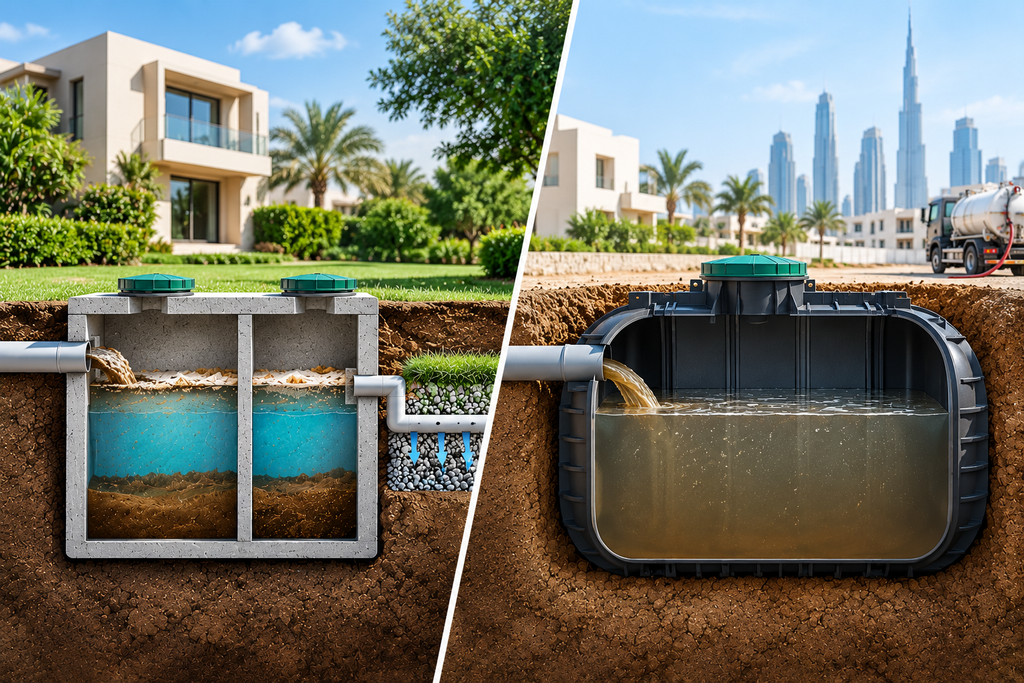
A septic tank partially treats wastewater on-site using natural bacterial action before releasing the liquid portion into the ground. A sewage tank (also called a holding tank) does no treatment at all it simply stores wastewater until a tanker comes to pump it out and take it away for treatment elsewhere.
This guide breaks down exactly what separates a septic tank from a sewage tank, and helps you figure out which one your villa, building, or site most likely has.
The Short Answer
In other words: a septic tank treats a little before it lets waste go somewhere; a sewage tank doesn’t treat anything, it just holds waste until someone removes it.
How a Septic Tank Works
A septic tank is an underground chamber, usually concrete, fiberglass, or plastic, where wastewater from toilets, sinks, and drains flows in and settles. Solids sink to the bottom and form a sludge layer, oils and grease float to the top, and naturally occurring anaerobic bacteria slowly break down the organic material. The partially treated liquid, called effluent, then flows out — often into a drain field or soakaway where the soil filters it further.
Septic tanks are designed for properties that aren’t connected to a centralized sewer network — commonly older villas, standalone plots, or rural-style compounds. They still need periodic pumping because the sludge layer builds up over time, but the frequency is usually longer than a pure holding tank because part of the waste is broken down naturally.
How a Sewage Tank Works
A sewage tank, sometimes called a holding tank, is a straightforward storage container. There’s no bacterial treatment process, no drain field, and no filtration — wastewater simply accumulates inside until it reaches capacity, at which point a tanker service pumps it out completely and transports it to an approved treatment facility.
This setup is far more common across Dubai’s newer villas, labor camps, construction sites, and commercial buildings that aren’t yet connected to the municipal sewer line. Since nothing is treated on-site, these tanks need more frequent and complete pumping compared to a septic system.
Septic Tank vs Sewage Tank: Quick Comparison
| Septic Tank | Sewage Tank | |
|---|---|---|
| Treatment | Partial, via bacteria | None — pure storage |
| Outlet | Drain field / soakaway | None (fully sealed) |
| Common in | Older villas, rural plots | New villas, labor camps, sites |
| Maintenance | Periodic desludging | Full pump-out on schedule |
| Environmental risk if neglected | Groundwater contamination | Overflow, odor, backup |
Which One Does Your Property Have?
If you’re not sure which system you have, a few quick checks help:
- Look for a drain field or soakaway area near the tank a patch of ground that stays slightly greener or damp. If it exists, you likely have a septic tank.
- Check if the tank has an outlet pipe leading away from it into the ground, versus being fully sealed with only an inlet. A sealed tank with no outlet is a sewage holding tank.
- Ask when your property was built and whether it’s connected to Dubai’s sewer network. Many newer developments in areas without direct sewer access use sealed holding tanks rather than traditional septic systems.
If you’re still unsure, a technician can confirm this during a routine inspection it takes only a few minutes to identify.
Why This Distinction Matters for Maintenance
Treating both systems the same way is a common mistake. A sewage holding tank that isn’t fully pumped out on schedule will overflow much faster than a septic tank, since nothing inside it is being broken down. Meanwhile, a septic tank that’s cleaned too aggressively or too often can actually disrupt the bacterial balance that makes it work.
Knowing which system your property has helps you set the right cleaning schedule instead of guessing. If you’d like a deeper look at cleaning frequency and cost specifically for septic systems, we’ve covered that in our complete septic tank cleaning guide.
Getting Either Tank Serviced in Dubai
Whether your property runs on a septic system or a sealed sewage holding tank, both eventually need professional pumping and disposal at a Dubai Municipality-approved facility. Trying to DIY either one isn’t practical the equipment, safety precautions, and legal disposal requirements make it a job for licensed operators.
Globalex handles both septic tank desludging and full sewage tanker removal across Dubai, with tankers from 1,000 to 15,000 gallons for villas, labor camps, and commercial sites. You can see our full range of options on our sewage tanker and waste water removal page.
Frequently Asked Questions
Is a septic tank the same as a sewage tank?
No. A septic tank partially treats wastewater on-site through bacterial breakdown before releasing effluent into a drain field. A sewage tank simply stores wastewater with no treatment until it’s pumped out.
Which one is more common in Dubai?
Sealed sewage holding tanks are more common in newer Dubai properties, especially villas, labor camps, and construction sites not yet connected to the municipal sewer network. Traditional septic tanks with a drain field are less common due to space and soil requirements.
Do both types need regular cleaning?
Yes, both need periodic pumping. Sewage holding tanks typically need more frequent, complete pump-outs since nothing is broken down inside them, while septic tanks are usually desludged on a longer cycle.
Can I check which type I have myself?
You can look for a drain field or outlet pipe near the tank as a rough indicator, but a technician can confirm it accurately during a routine visit.
Need Your Tank Identified or Serviced?
Whether it’s a septic system or a sewage holding tank, Globalex provides Dubai Municipality-approved pumping, cleaning, and disposal for residential, commercial, and industrial properties.
Get a Free Quote | WhatsApp Us

