

Industrial & Commercial Water Tank Cleaning in Dubai
Quick Answer: Industrial and commercial water tank cleaning in Dubai means draining the tank, removing sludge and biofilm, scrubbing and inspecting it, disinfecting it, rinsing and refilling. Dubai Municipality’s drinking water guideline says all water tanks should be emptied, cleaned and disinfected with 50 mg/L of chlorine at least twice a year. It also requires the cleaning company to be approved by the Municipality.
A warehouse, hotel or labour accommodation can store a large volume of water in tanks that most occupants never see. When those tanks are neglected, the problem can reach every tap, shower and kitchen they supply. This guide to industrial and commercial water tank cleaning in Dubai is for facility managers, building owners, HSE officers and procurement teams. It explains the official rules, a safe cleaning sequence, the records to keep and how to compare contractors.
What Is Industrial and Commercial Water Tank Cleaning in Dubai?
It is the planned cleaning and disinfection of water storage tanks at business, institutional and industrial premises. The job removes sediment, scale, algae and biofilm from internal surfaces, then disinfects them before the tank returns to service.
Commercial tanks serve offices, hotels, malls, restaurants, schools, hospitals, gyms and residential towers. Industrial tanks serve factories, warehouses, workshops and labour accommodation. They may be larger, taller or linked in multi-tank systems.
Common types include:
- Underground concrete tanks
- Rooftop and ground-level GRP (glass reinforced plastic) tanks
- Sectional panel tanks
- Bolted or welded steel tanks
- Polyethylene tanks
Identify what each tank holds before any work starts. The Municipality rules in this guide apply to unbottled drinking water and its distribution systems. Process water, fire water, treated sewage effluent (TSE) and wastewater tanks need their own method and risk assessment.
Why Does Commercial Water Tank Cleaning Matter?
A storage tank sits between the incoming supply and your building’s outlets. Clean water entering a dirty tank may not stay clean. Settled sludge, corrosion and scale give microorganisms places to grow. Stagnant water and poor temperature control add to the risk, including from Legionella, the bacteria behind Legionnaires’ disease. The Municipality guideline states that cold water should be kept below 20°C. That is demanding in a Dubai summer, especially for exposed rooftop tanks.
Dubai Municipality Water Tank Cleaning Requirements
The key reference is DM-HSD-GU17-DW2, Technical Guidelines for Quality of Unbottled Drinking Water (Version 1, 25 September 2024). It covers commercial buildings, hotels, schools, labour cities and other built environments.
| Building duty | What the guideline says |
|---|---|
| Tank cleaning | Empty, clean and disinfect with 50 mg/L chlorine at least twice a year |
| Visual checks | Carry out regular inspections at least weekly to prevent dirt and organic build-up |
| Internal inspection | Protect tanks, keep covers secure and inspect inside at least monthly |
| Water testing | Use a laboratory accredited by the Emirates International Accreditation Center (EIAC) every six months |
| After routine cleaning | Take a water sample one week after the six-monthly clean and disinfection |
| Contractor | Use a company approved by the Dubai Municipality Food Safety Department, Registration and Permit Section |
Testing follows the UAE unbottled drinking water standard, UAE.S GSO 149:2021. The guideline lists an AED 1,000 fine for violating health conditions for cleaning drinking water tanks. It describes a notice and correction period before a fine for a party that fails to take corrective action. Other legal measures may also apply. Always check the latest official requirements, plus any rules from your free zone or site authority.
Key Benefits of Professional Tank Cleaning
- Better water hygiene: Removing deposits and disinfecting surfaces helps protect stored water.
- Less strain on equipment: Less sediment lowers the chance of clogged pumps, float valves, strainers and filters.
- Early fault detection: An inspection can reveal cracks, leaks, corrosion, failed seals or damaged covers.
- Stronger audit files: Dated reports help show how your water system is maintained.
- Fewer surprises: Planned visits are easier to manage than urgent work after a complaint or failed sample.
- Better user experience: Cleaning can help when tank deposits are causing odour, colour or taste problems.
Common Problems and Challenges
Warning Signs
Arrange an inspection if you notice:
- Cloudy, yellow or brown water
- Musty or unusual odours
- Grit in taps, strainers or filters
- Slime, algae or insects in or around the tank
- Falling water pressure or frequent filter blockages
- Damaged covers, vents or overflow screens
- Rust streaks, wet joints or leaking panels
These signs do not always mean the tank is the source, so pipework and the incoming supply may also need checking. Clear water is not proof of safety either, because many microorganisms cannot be seen.
If contamination is suspected or a sample fails, do not rely on a routine clean alone. The guideline calls for notifying the Municipality, preventing consumption until treatment is addressed, informing users and providing safe alternative water. The wider system may need cleaning and disinfection too.
Site Challenges
Business sites also face limited shutdown windows, restricted hatches, rooftop access, interconnected pipework and round-the-clock demand. A site survey should settle these points before cleaning day.
Important Factors to Consider Before Booking
Contractor Approval
Ask for current proof of the company’s Dubai Municipality approval for water tank cleaning. A general trade licence is not the same as this approval. Also ask for workers’ confined space training certificates.
Confined Space and Height Safety
Tank interiors can expose workers to low oxygen, hazardous gases, chemical vapours, slips and falls. Your contractor should provide a risk assessment and method statement covering entry permits, gas testing, ventilation, isolation, a standby attendant and rescue arrangements. Elevated tanks also need a work-at-height plan.
Operational Continuity
Can one tank or compartment stay in service while another is cleaned? That depends on the design and isolation valves. If not, plan for downtime, temporary supply and refill time.
What Affects the Cost?
A useful quotation reflects:
- Tank number, capacity and material
- Access, height and location
- Sludge volume and surface condition
- Wastewater removal
- Disinfection and laboratory sampling
- Working hours and shutdown limits
- Refill water, if required
Ask which items are included. A low headline price may leave out sampling, sludge disposal or refilling.
Best Practices and Expert Recommendations
- Keep a tank register. Record each tank’s location, capacity, material, water use and last cleaning date.
- Schedule both annual cleans in advance. Treat twice a year as the minimum for drinking water tanks. Add cleaning when inspections or test results show a need.
- Match sampling to cleaning. Book the accredited laboratory for one week after the routine clean.
- Check the whole system. Include connected tanks, pipes, pumps, filters and dead legs in your water safety plan.
- Empty tanks sensibly. Time the shutdown for low demand and avoid unnecessary water waste.
- Fix defects promptly. A clean tank with a broken cover can quickly become contaminated again.
- Organise your records. Keep cleaning reports, contracts, disinfection records, chemical Safety Data Sheets, inspection findings and lab results. Check the guideline’s retention periods, which vary by record type and system.
How Professional Water Tank Cleaning Services Help
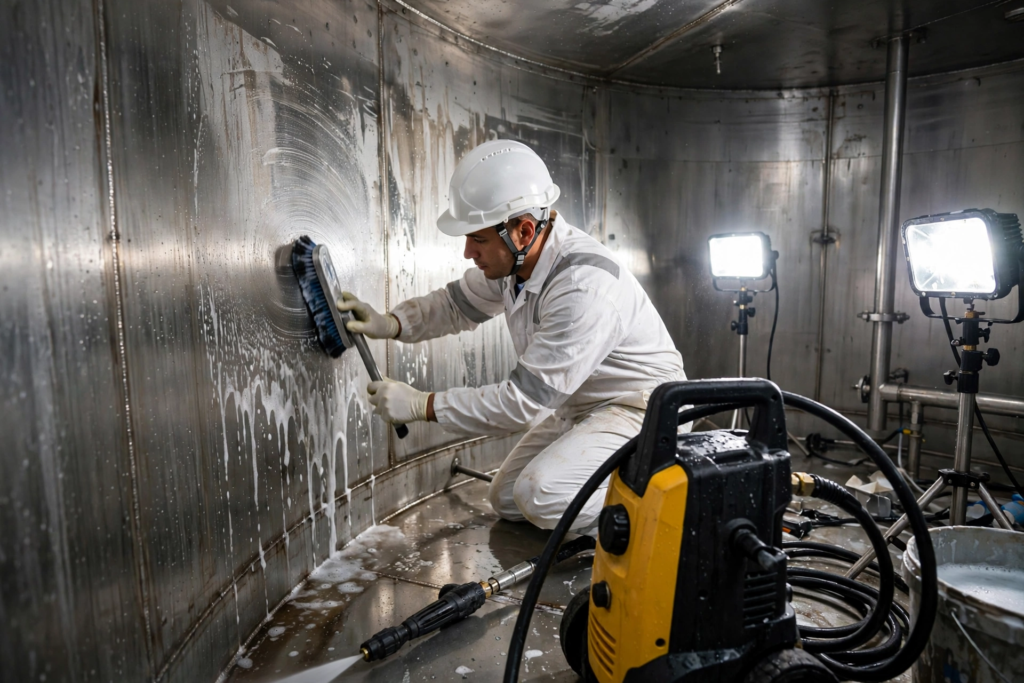
Large-site cleaning is more than washing visible surfaces. A competent provider plans safe access, removes water and sludge, chooses methods suited to the tank lining, applies disinfectant correctly and rinses before handover. High-pressure cleaning can be useful, but pressure and tools must suit the surface. Excessive force may damage coatings, joints or ageing material. Where deposits affect connected lines, ask whether water jetting or a separate pipework treatment is appropriate. Professionals should also tell you about problems that cleaning cannot fix. Under the guideline, cleaning companies must formally inform the owner or tank manager of safety or water problems, including leaks, overflow or weak flow, and follow up on corrective action. They must also keep reports showing the chemicals and methods used.
Why Choose Globalex?
Established in 2006, Globalex is a Dubai-based group whose services include tank cleaning, water supply and liquid waste handling. For facility teams, that connection matters.
- Related services from one contact: Discuss tank cleaning, wastewater removal and water refilling in one enquiry.
- Tanker support: We supply sweet water and potable water. Confirm the water your tank requires and the delivery schedule when booking.
- Safety and records: Our crews follow confined space safety procedures, and we provide a service record after every job.
- Clear scope: Our quotations state what is included, so your team can compare and plan.
Before confirming any booking, ask us for the approvals, training certificates and documents your site requires. We recommend the same check for every contractor.
Our Water Tank Cleaning Service Process
The final method depends on tank design, condition, water use and site risks.
- Enquiry and Site Assessment: Share your location, tank types, capacities, number of tanks, access details and known problems. We arrange a visit to assess the job.
- Quotation and Planning: We set out the scope, including any water refill. Timing, shutdown arrangements, permits, laboratory sampling and responsibilities should be agreed before work starts.
- Isolation and Safety Checks: The tank and connected equipment are isolated as required. Access, ventilation, atmospheric testing and confined space controls must be in place before anyone enters.
- Draining and Desludging: The crew pumps out remaining water and removes sludge and loose sediment. Wastewater and residue should go through an appropriate, authorised disposal route.
- Scrubbing and Inspection: Walls, floor and corners are cleaned with suitable manual and mechanical methods. Accessible covers, float valves, pipe connections and surfaces are checked for visible defects.
- Disinfection and Rinsing: An approved disinfectant is applied using the Municipality-approved method and required contact time. Surfaces are then rinsed and residue removed.
- Refill and Handover: The tank is returned to the network supply or refilled by tanker as agreed. You receive a service record and advice on your next cleaning date. Arrange the follow-up laboratory sample and file its result with your records. A service record is not a laboratory test result.
Frequently Asked Questions
Under DM-HSD-GU17-DW2, all water tanks in scope should be emptied, cleaned and disinfected at least twice a year. Inspections may show that additional work is needed.
Yes. For drinking water tanks, the guideline says the company must be approved by the Food Safety Department, Registration and Permit Section. Ask to see current proof.
The guideline calls for sampling one week after the six-monthly clean and disinfection. It requires testing through an EIAC-accredited laboratory every six months. Emergencies, contamination findings and major system changes can also require sampling.
It depends on capacity, access, sludge level, number of tanks, safety controls and refill method. Ask for separate estimates for cleaning and refilling.
In-house teams can support inspections and housekeeping within their training. For drinking water tank cleaning and disinfection, use an approved company. Nobody should enter a confined space without proper training, authorisation and controls.
Keep the cleaning and disinfection report, service contract, chemical details and Safety Data Sheets, inspection findings, corrective actions and laboratory results.
No. Cleaning removes contamination and may expose defects. Leaks, structural corrosion and failed linings need assessment and repair by a suitably qualified provider, using materials suitable for the tank’s water use.
Conclusion
Good tank hygiene is a maintenance system, not a once-a-year reminder. For drinking water tanks, plan at least two cleans a year, inspect between visits, test the water through an accredited laboratory and keep your records ready. The right contractor should show the required approval, explain how workers will stay safe and state exactly what you will receive. That gives your team a sound basis for comparing quotations beyond price.
Request a Water Tank Cleaning Quote
Is your next clean due, or has an inspection found a concern? Send Globalex your site location, tank type, capacity, number of tanks and preferred date. Ask us to include wastewater removal or tanker refilling if you need it.
- Call: +971 55 928 6666 or 04 283 7999
- WhatsApp: Send your tank details
- Email: gm@globalex.ae
- Online: Request a free quote
- Visit: Office No. 1501, Mai Tower Building, Al Nahda 1, Dubai, UAE
Plan your next tank clean before it becomes urgent. Contact Globalex today.

