

Pool Losing Water? Leak or Evaporation: How to Do the Bucket Test (Dubai Guide)
Quick Answer: To tell whether your pool is leaking or just evaporating, do the bucket test. Fill a bucket with pool water, place it on a pool step so its water level matches the pool, mark both levels, and leave it for 24 hours without swimming or topping up. If the pool drops by about the same amount as the bucket, the cause is evaporation. If the pool drops noticeably more, you likely have a leak. Repeat with the pump off to help narrow down where it is. Evaporation is normal, and in Dubai’s heat it can be significant, so cover the pool and top up with clean sweet water. If the test points to a leak, call a pool contractor or leak specialist before refilling repeatedly. Globalex supplies sweet water for pool top-ups and refills across Dubai.
Key Takeaways
- Evaporation affects the pool and the bucket equally. A leak affects only the pool.
- Do the test with normal pump operation first, then repeat with the pump off.
- Do not swim, backwash, or top up during the test.
- Do not drain a pool without professional advice, because groundwater can damage an empty pool.
- Constant top-ups without finding the cause waste water and money.
Introduction
You top up the pool on Monday. By Thursday, the water has dropped below the skimmer again, and the pump is starting to sound strange.
Every pool owner in Dubai has asked the same question: is this just the heat, or is something wrong? The answer matters. Evaporation is normal and manageable. A leak is not, and a leak can damage the structure, the ground around it, and your water bill.
This guide explains how to tell pool losing water leak or evaporation apart with the bucket test, what normal loss looks like, which signs point to a leak, and what to do next.
Pool Losing Water: Leak or Evaporation? Start with the Bucket Test
The bucket test is a simple comparison. It uses a bucket of pool water as a control, because the water in the bucket loses water only through evaporation. If the pool loses more than the bucket, something else is taking water out.
It works because both the bucket and the pool are exposed to the same sun, wind, and temperature. The only difference is that the pool can also leak, and the bucket cannot.
Two things make the result reliable: running the test for a full 24 hours, and avoiding anything else that changes the water level, such as swimming, backwashing, or topping up.
How to Do the Bucket Test Step by Step
- Prepare the pool. Let the water level settle at its normal operating height, around the middle of the skimmer opening. Switch off any automatic water leveler or autofill so it cannot add water.
- Fill a bucket. Use a clean bucket and fill it with pool water to roughly 5 cm (2 inches) from the top.
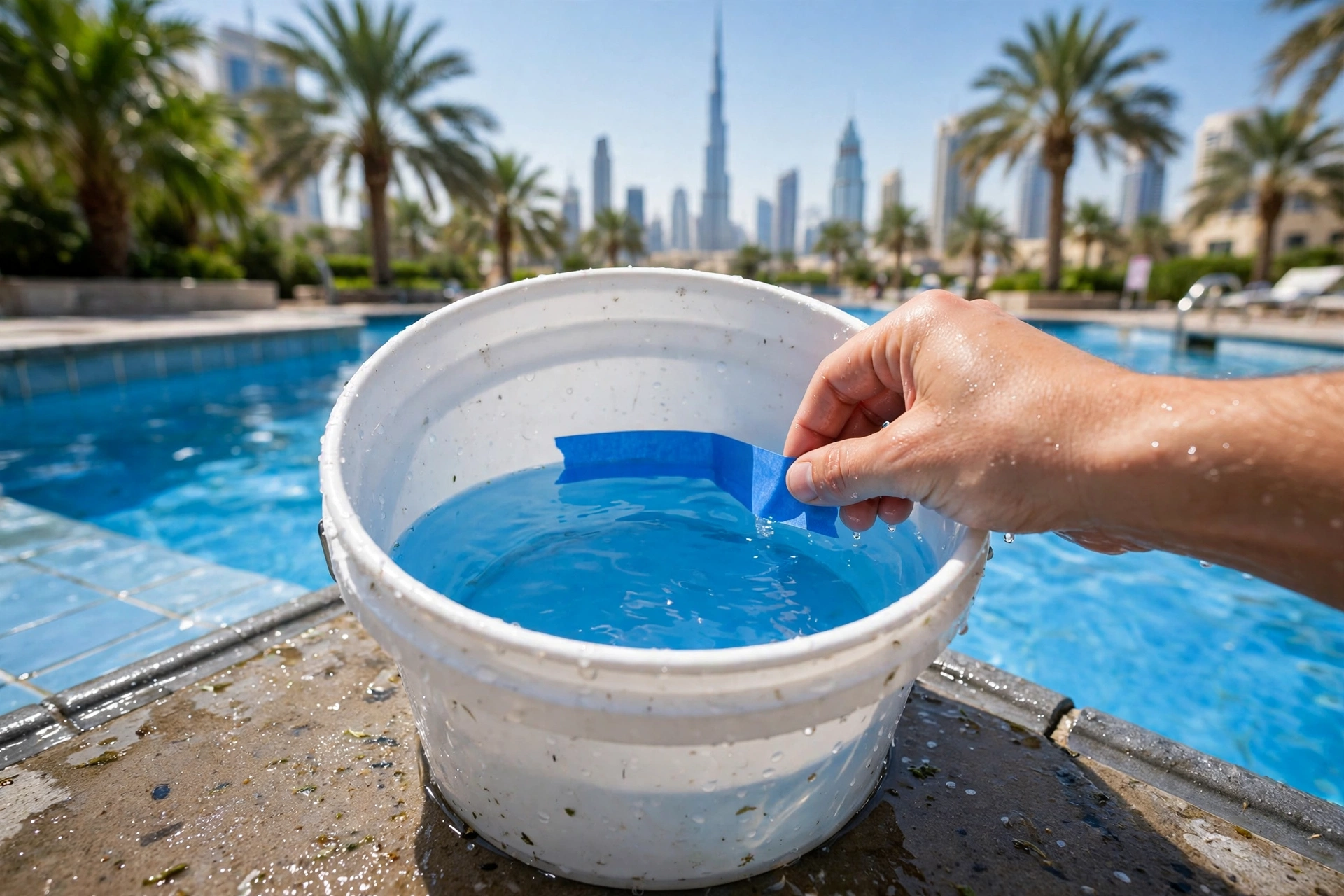
- Place it on a step. Set the bucket on a pool step, so the bucket sits partly underwater and its inside water level is close to the pool level. Weigh it down with a stone or some pool water in the bottom so it does not float or tip.
- Mark both levels. Use a waterproof marker or tape to mark the water level inside the bucket. Then mark the pool water level on the outside of the bucket, or on the tile or step wall.
- Run the pump normally. Keep the pool circulation at its usual schedule for the next 24 hours.
- Avoid disturbances. Do not swim, backwash, top up, or run water features during the test.
- Measure after 24 hours. Compare how far each level has dropped from its mark.
How to Read the Results
| Result after 24 hours | What it usually means | What to do |
|---|---|---|
| Pool and bucket drop by about the same amount | Evaporation, which is normal | Reduce evaporation and top up as needed |
| Pool drops clearly more than the bucket | Likely leak | Run the pump-off test and call a specialist |
| Bucket drops more than the pool | Test setup problem, such as wind or a bucket in the wrong spot | Repeat the test |
If the pool has lost more than the bucket, repeat the test with the pump switched off for the full 24 hours.
- If the pool loses less with the pump off, the leak is more likely on the pressure side of the plumbing, such as return lines or pipework.
- If the pool loses about the same with the pump off, the leak is more likely in the shell, skimmer, light fitting, or structure.
This is a guide, not a diagnosis. A qualified specialist can confirm the exact location with pressure testing, dye testing, or listening equipment.
Why Pool Water Loss Matters in Dubai
Dubai’s climate pushes evaporation higher than many places. Strong sun, wind, and low humidity all pull water off an uncovered pool surface. A commonly cited range for evaporation in warm weather is a few millimeters a day, and hot, windy conditions can exceed that. Use it as a reference point only, and rely on your own bucket test as the real benchmark.
Water loss also affects equipment. When the level falls below the skimmer, the pump draws air and can run dry, which risks damage. Chemical balance shifts as water level changes, and algae can take hold faster.
Leaks matter for a different reason. Water that escapes the pool can wash away soil under the deck, damage the structure, and raise your DEWA bill if an autofill system keeps replacing it unnoticed.
Signs of a Pool Leak
Look for more than one of these before assuming the worst:
- The bucket test shows the pool losing more than the bucket.
- The pool keeps losing water when the pump is off.
- The level drops and then stops at a certain height, which can point to the leak’s location, such as a skimmer, light, or return fitting.
- Wet or soft ground, sunken paving, or damp patches near the pool or equipment area.
- Visible cracks in tiles, plaster, or coping.
- Air bubbles at return jets or air in the pump basket.
- Your water bill rises, or your autofill runs far more than usual.
- Algae keeps returning despite correct chemistry.
Common Problems and Challenges
- Blaming evaporation for everything. Owners keep topping up for weeks without testing, and a slow leak grows.
- Blaming a leak for normal loss. Others pay for leak detection when the bucket test would have shown ordinary evaporation.
- Autofill masking the problem. An automatic leveler keeps the water level steady, so a leak can run for months before anyone notices.
- Testing badly. Swimming, backwashing, or topping up during the test ruins the result, and wind can move the bucket.
- Draining the pool. Emptying a pool to look for a leak can be dangerous. Groundwater pressure can lift or crack an empty pool shell, so ask a professional first.
- Heat. In summer, the pool can lose water quickly, which makes small leaks harder to spot.
Important Factors to Consider
Pool size. A small drop on a large pool is a big volume of water. A pool of about 8 m x 4 m x 1.4 m holds roughly 45 m3, or about 10,000 imperial gallons, so even a few centimeters is a lot of water.
Usage. Splash-out, kids, backwashing, and water features all remove water. Subtract them before you suspect a leak.
Weather. Wind and heat raise evaporation. Run the test on a normal day, not during a sandstorm.
Cover and shade. Uncovered, sunny pools lose much more water than shaded or covered pools.
Autofill. Turn it off during the test, and check it afterward.
Equipment. Check the pump basket, filter, and skimmer for air or damage.
Best Practices and Expert Recommendations
Run the bucket test before you assume a leak, and again whenever the loss changes.
Mark your normal water level on the tile or skimmer, and check it weekly. Small, regular checks catch problems early.
Use a pool cover when the pool is not in use. It is one of the simplest ways to reduce evaporation, along with shade and wind protection.
Switch off water features and fountains during the hottest part of the day if you want to reduce loss.
Check your autofill. If it runs often, treat that as a warning sign, not a convenience.
If the bucket test points to a leak, call a pool contractor or leak detection specialist. Do not keep topping up blindly, and do not drain the pool without advice.
After repairs, refill with clean, potable sweet water, and have the filtration and chemistry checked before you swim.
Top up in smaller, regular amounts during peak summer instead of waiting for a big drop.
How Professional Services Help
A leak specialist finds the exact source using pressure testing, dye, and listening equipment, and a pool contractor repairs it. That is a different job from supplying water, and the right specialist saves you from repeated guesswork.
A water supply and pool service provider helps with the rest. After a repair, a refill needs the right volume, delivered quickly, with clean water. During the hot months, scheduled top-ups keep the level steady without tying up your plumbing.
Regular pool cleaning also helps, because a technician checking your pool each week is more likely to notice falling levels, wet equipment areas, and cracks early.
Why Choose Globalex
Globalex supplies treated sweet water for pool fills and top-ups across Dubai, alongside swimming pool cleaning, water tank cleaning, and wastewater services. We work with major developers and facility managers, including Emaar, Dubai Properties, and Meraas.
We are not a leak detection company, and we will tell you so. If your bucket test shows a leak, we recommend you bring in a specialist first. Once the repair is done, we can refill the pool quickly with potable sweet water, and we can set up a recurring top-up schedule for the summer months.
Our quotes are clear before dispatch, and we match tanker size to your pool so you do not pay for extra trips.
Our Service Process
- Contact us with your pool dimensions or approximate volume and your location.
- We confirm the right tanker size and give you a clear quote.
- We schedule delivery around your access and timing needs, including after repairs.
- Our tanker delivers treated sweet water directly into your pool.
- We can set up recurring top-ups, and our pool cleaning team can help keep the pool in good condition.
Frequently Asked Questions
Do the bucket test. If the pool drops by about the same amount as a bucket of pool water placed on a step, the cause is evaporation. If the pool drops more, you likely have a leak.
It depends on weather, wind, cover, and use. A commonly cited range in warm weather is a few millimeters a day, and Dubai’s heat and wind can push it higher. Your bucket test is the better benchmark for your own pool.
A full 24 hours, without swimming, backwashing, or topping up. Repeat with the pump off if you suspect a leak.
It points to a leak on the pressure side of the plumbing, such as return lines or pipework. A specialist can confirm the exact location.
Not without professional advice. An empty pool can be damaged by groundwater pressure, and draining wastes a lot of water.
Yes. It keeps the level steady, so a leak can run for a long time. Turn it off during the test, and check how often it runs.
Use a pool cover when the pool is not in use, add shade or wind protection, and switch off water features during the hottest hours.
Yes. We deliver treated sweet water by tanker to pools across Dubai and can set up recurring top-ups.
Conclusion
A falling pool level is not always a leak, and it is not always safe to ignore. The bucket test gives you a clear, cheap answer in 24 hours, and the pump-off test helps you narrow it down.
If it is evaporation, cover the pool and top up with clean water. If it is a leak, bring in a specialist, avoid draining without advice, and refill properly once it is fixed.
Call to Action
Need a sweet water top-up or a refill after repairs? Call Globalex at +971-55-9286666, message us on WhatsApp, or request a free quote at globalexuae.com. Share your pool dimensions and location, and we will confirm the right tanker and a clear price.

