

Water Tanker vs DEWA Water Bill: Which Is Cheaper for Villa Pools in Dubai (2026)?
Short Answer: On cost per liter alone, DEWA water is cheaper than tanker water. Filling a typical villa pool of about 10,000 imperial gallons (roughly 45 m³) adds around AED 440 to AED 520 in DEWA water charges, while a tanker delivery of the same volume typically costs AED 800 to AED 1,300. A water tanker becomes the better choice when your villa has no active DEWA connection yet, when you need the pool filled in hours instead of days, or when your tap supply cannot keep up.
Introduction
Every villa owner in Dubai eventually asks the same question when a pool needs filling: do I just run the hose, or do I call a water tanker? The question gets sharper in 2026, because DEWA’s slab tariff makes every extra cubic meter more expensive once monthly consumption crosses certain thresholds, and a pool fill is a large, sudden jump in usage.
We supply sweet water by tanker across Dubai, so we could easily tell you the tanker is always cheaper. It is not, and pretending otherwise would not help you. This article compares the real numbers, shows where each option makes sense, and helps you choose based on your situation rather than a sales pitch.
What Is the Difference Between DEWA Water and Tanker Water for Pools
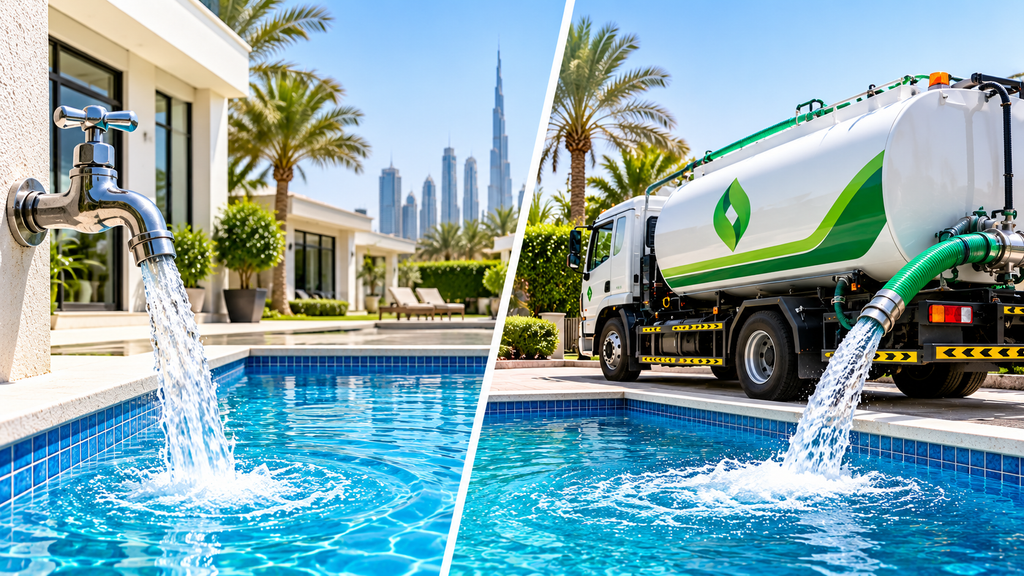
DEWA water is the potable supply delivered through the municipal network to your villa’s meter, billed monthly under a slab tariff set in line with the decision of the Dubai Supreme Council of Energy. Tanker water is sweet water, treated to potable standard, delivered in bulk by truck and pumped directly into your pool or underground tank.
Both are safe for pool use. The differences are price structure, speed, and availability. DEWA bills you per cubic meter on a sliding scale. A tanker bills per delivery, based on volume, location, and urgency.
DEWA Water Tariff in 2026: What You Actually Pay
According to DEWA’s published slab tariff, residential water is charged on three tiers each month:
| Monthly consumption | Rate (AED per m³) |
|---|---|
| 0 to 27 m³ | 7.70 |
| 27 to 54 m³ | 8.80 |
| Above 54 m³ | 10.12 |
On top of that, DEWA applies a fuel surcharge, listed at AED 1.10 per m³ for October 2026, plus 5% VAT. The surcharge changes with fuel prices, so check the current figure on DEWA’s tariff page before you budget.
For scale, one cubic meter is about 220 imperial gallons. A pool holding 10,000 gallons therefore needs roughly 45 m³.
Water Tanker vs DEWA Water Bill: A Real Cost Comparison
Here is what a 10,000-gallon (about 45 m³) pool fill adds to your costs, using the DEWA figures above for water charges only.
| Scenario | DEWA water charges (approx.) | Tanker delivery (typical market range) |
|---|---|---|
| New villa, no other usage that month | AED 441 | AED 800 to AED 1,300 |
| Villa already using 40 m³ that month | AED 516 added | AED 800 to AED 1,300 |
Even when the fill pushes your bill into the top tier, the marginal DEWA rate works out to roughly AED 11.78 per m³ after the fuel surcharge and VAT. A 10,000-gallon tanker delivery at AED 800 to AED 1,300 comes to roughly AED 17.60 to AED 28.60 per m³.
So the honest answer is that DEWA wins on price per unit. Other bill items, such as sewerage or housing fees, sit outside these figures. Tanker prices also vary by supplier, distance, and urgency, so treat the range as a guide and ask for a written quote.
Why This Comparison Matters for Villa Owners
Pools in Dubai are not a one-time expense. Evaporation in summer can drop the level noticeably within weeks, and any resurfacing, tile repair, or leak fix means draining and refilling. Over a year, you may fill or top up several times.
The cost gap per fill looks small in isolation. Across repeated top-ups, a new pool owner, a landlord managing several villas, or a property manager handling a community will feel it. That is why it pays to know when the tap makes sense and when it does not.
When a Water Tanker Is the Better Choice
Price is only part of the decision. A tanker wins in specific situations, and these come up often.
Your villa has no active DEWA connection yet. New handovers in developing communities sometimes wait on utility activation. A pool contractor or snagging team may need water on site before the permanent supply is live. A tanker bridges that gap.
You need the pool filled quickly. Filling 45,000 liters through a garden hose can take a day or more, depending on pressure. A tanker can deliver and pump the full volume in a couple of hours. This matters for events, handover deadlines, and rental turnarounds.
Your plumbing or pressure is limited. Running a hose for many hours ties up your supply and can affect household water pressure. A tanker leaves your internal system untouched.
You are refilling after draining for repairs. A pool left empty is exposed to heat and structural stress. Speed reduces risk.
You want to avoid a large spike on one bill. Spreading consumption through the tap is not always possible, and a big fill can trigger a high water usage alert from DEWA, which may prompt questions or unnecessary leak checks. A separate tanker delivery keeps your metered usage predictable.
Common Problems and Challenges
The most common mistake is estimating the pool volume wrong. Owners guess, order a tanker that is too small, and pay for a second trip. Measure length, width, and average depth, and multiply to get cubic meters. A pool of 8 m by 4 m with an average depth of 1.4 m holds about 45 m³.
Another problem is water quality. Filling from an untreated or unknown source can introduce sediment, algae spores, or mineral imbalance that costs far more to correct than you saved. Always confirm the water is potable-grade sweet water.
Finally, many owners fill the pool at the wrong time. Filling before the shell, tiling, and plumbing are fully cured, or before the filtration system is commissioned, creates avoidable problems.
Important Factors to Consider
Check your pool volume first, then your current monthly DEWA consumption, since the tier you are already in determines your marginal rate. Ask whether your connection is active and whether your tap pressure can support a long fill.
Consider timing. A scheduled tanker delivery costs less than an urgent same-day one. Consider access too: tankers need clear road access, and narrow villa lanes or gated communities may limit tanker size.
Finally, consider how often you will need water. One-off fills favor the tap if everything is connected. Ongoing top-ups across several properties often benefit from a scheduled delivery arrangement.
Best Practices and Expert Recommendations
If your DEWA connection is active and your pressure is decent, filling or topping up through the tap is usually the cheapest route. Fill gradually, monitor the level, and keep your pump and skimmer from running dry.
If you manage a new villa, a rental turnover, or a pool that needs refilling quickly, book a tanker. Share your pool dimensions in advance so the supplier can match tanker capacity and avoid a second trip.
Run the bucket test before you assume a leak. Place a bucket on a pool step, mark both water levels, and compare after 24 hours. Equal drops point to evaporation, not a leak.
During peak summer, small, regular top-ups hold the level steady and avoid large sudden fills that stress your bill and your system.
How Professional Services Help
A professional water tanker supplier removes the guesswork. They size the delivery to your pool, use clean potable water, and pump directly into the pool without tying up your plumbing. For new handovers and construction phases, they provide water when the network is not yet available.
They also help you plan. A supplier who knows your pool size and your usage pattern can recommend whether a one-time fill, a seasonal top-up schedule, or a mix of tap and tanker is the smartest approach for your property.
Why Choose Globalex
Globalex supplies sweet water across Dubai for villas, developments, and commercial sites, working with major names such as Emaar, Dubai Properties, and Meraas. We run tankers in multiple capacities, so we match the truck to your pool instead of overselling volume.
We quote clearly, including tanker size, delivery, and any access charges, so you can compare us against the DEWA numbers above with real figures. If your situation suits the tap, we will tell you. If it suits a tanker, we will deliver on time with water that meets potable standards.
Our Service Process
- Contact us with your pool dimensions or approximate volume and your villa location.
- We confirm the right tanker size and give you a written quote.
- We schedule delivery around your access and timing needs.
- Our tanker arrives, connects to your pool or tank, and pumps the water in.
- We can set up recurring top-ups for summer or for multiple properties.
Frequently Asked Questions
Is DEWA water cheaper than tanker water for a villa pool? Yes, on cost per cubic meter. A 10,000-gallon fill adds roughly AED 440 to AED 520 in DEWA water charges, compared with a typical tanker range of AED 800 to AED 1,300. A tanker is chosen for speed, availability, and convenience rather than price.
How much does it cost to fill a villa pool in Dubai? It depends on pool size and the source. A pool of about 45 m³ costs around AED 440 to AED 520 through DEWA water charges, or AED 800 to AED 1,300 by tanker, based on typical market rates. Ask for a quote based on your exact dimensions.
Will filling my pool push me into DEWA’s highest tariff slab? It can. The top tier applies above 54 m³ per month at AED 10.12 per m³, before the fuel surcharge and VAT. A large fill on top of normal household use may cross that threshold.
Can I get a water tanker before my DEWA connection is active? Yes. Tanker delivery does not depend on a DEWA connection, which makes it useful for new handovers and construction phases.
Is tanker water safe for swimming pools? Yes, when it is potable-grade sweet water. Avoid TSE or salt water for pools, as those serve irrigation and industrial uses.
How long does it take to fill a pool with a tanker? A tanker can typically deliver and pump the full volume in a couple of hours, depending on pool size and the number of trips needed.
Conclusion
DEWA water is the cheaper source per liter, and for a connected villa with decent pressure, the tap is usually the economical way to fill or top up a pool. A water tanker earns its place when speed, availability, or convenience matters more than the per-liter rate: new handovers, tight deadlines, limited plumbing, and repeated refills across several properties.
Measure your pool, check your current DEWA tier, and compare real quotes. That gives you a decision based on your numbers, not on guesses.
Call to Action
Need a quote for a pool fill or a scheduled top-up? Call Globalex at +971-55-9286666, message us on WhatsApp, or request a free quote at globalexuae.com. Share your pool size and location, and we will confirm the right tanker and a clear price.

