

How to Choose the Right Portable Water Storage Capacity for Your Farm in the UAE
Introduction
Water is one of the most valuable resources for agricultural operations across the UAE. Whether you operate a small livestock farm in Ajman, a greenhouse in Dubai, or a large agricultural project in Abu Dhabi, selecting the correct portable water storage capacity directly impacts operational efficiency, crop health, livestock welfare, and long-term costs.
Many farm owners invest in water storage tanks without accurately calculating their daily water demand. The result is either insufficient storage capacity that disrupts operations or oversized tanks that increase unnecessary expenses.
This guide explains how to determine the ideal portable water storage capacity for your farm while considering UAE climate conditions, water delivery schedules, livestock requirements, irrigation needs, and future expansion plans.
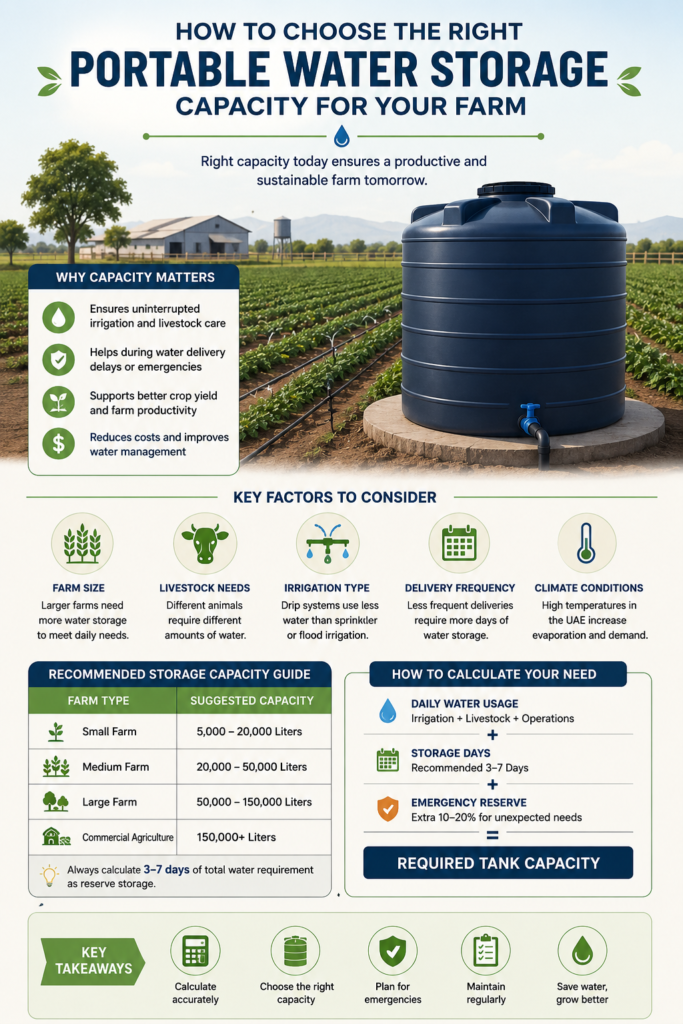
Key Takeaways
- Calculate total daily water consumption before selecting a tank.
- Consider crops, livestock, irrigation systems, and workforce requirements.
- Maintain at least 3–7 days of backup water storage.
- UAE climate conditions require higher storage reserves due to evaporation and extreme temperatures.
- Portable water tanks offer flexibility for expanding farms and temporary agricultural projects.
- Proper tank sizing reduces operational costs and water shortages.
Why Water Storage Capacity Matters
A properly sized water storage system ensures:
- Consistent irrigation
- Reliable livestock watering
- Emergency preparedness
- Reduced operational interruptions
- Better crop yields
- Improved water management efficiency
Insufficient storage can cause irrigation delays, crop stress, livestock health issues, and increased dependence on emergency water deliveries.
Factors That Determine Farm Water Requirements
Farm Size
Larger farms naturally require greater storage capacity. Acreage directly influences irrigation demand and reserve requirements.
Type of Crops
Different crops consume different amounts of water.
High-demand crops:
- Vegetables
- Fruits
- Greenhouse crops
Lower-demand crops:
- Native plants
- Certain drought-resistant crops
Livestock Requirements
Daily water requirements vary by animal type:
| Livestock Type | Average Daily Water Consumption |
|---|---|
| Cattle | 30–70 Liters |
| Goats | 5–15 Liters |
| Sheep | 4–12 Liters |
| Horses | 25–55 Liters |
| Poultry | 0.2–0.5 Liters |
Irrigation Method
Water demand differs significantly based on irrigation systems.
- Drip irrigation (most efficient)
- Sprinkler systems
- Surface irrigation
- Pivot irrigation systems
Water Delivery Frequency
If tanker deliveries occur weekly, larger storage reserves are required than farms receiving daily deliveries.
How to Calculate Daily Farm Water Consumption
Step 1:
Calculate irrigation demand.
Step 2:
Calculate livestock demand.
Step 3:
Calculate operational water usage.
Step 4:
Add emergency reserves.
Formula:
Required Tank Capacity =
(Daily Water Usage × Storage Days) + Emergency Reserve
Example:
Daily Usage: 10,000 Liters
Desired Storage: 5 Days
Emergency Reserve: 5,000 Liters
Required Capacity:
55,000 Liters
Recommended Water Storage Capacities
| Farm Type | Suggested Capacity |
| Small Farm | 5,000–20,000 L |
| Medium Farm | 20,000–50,000 L |
| Large Farm | 50,000–150,000 L |
| Commercial Agriculture | 150,000+ L |
Portable vs Permanent Water Storage Tanks
| Feature | Portable Tanks | Permanent Tanks |
| Mobility | High | Low |
| Installation Cost | Lower | Higher |
| Flexibility | Excellent | Limited |
| Expansion | Easy | More Difficult |
| Temporary Projects | Ideal | Less Suitable |
Portable water storage systems are especially beneficial for expanding agricultural operations and temporary farming projects.
Rigid vs Flexible Portable Water Storage Tanks
Rigid Tanks
Advantages:
- Long lifespan
- Better structural integrity
- Suitable for permanent deployment
Flexible Tanks
Advantages:
- Easy transportation
- Fast installation
- Lower storage footprint
- Ideal for emergency water storage
Cost Factors
Several factors influence total investment:
- Tank material
- Capacity
- Installation requirements
- Transportation costs
- Site accessibility
- Maintenance requirements
- UV protection systems
Common Mistakes to Avoid
Underestimating Water Demand
Future expansion often increases consumption.
Ignoring Seasonal Changes
Summer water demand in the UAE can increase significantly.
Not Planning Emergency Reserves
Unexpected delivery delays can disrupt operations.
Choosing Based on Price Alone
Low-cost tanks may increase maintenance costs over time.
UAE-Specific Considerations
Farm operators in:
- Dubai
- Abu Dhabi
- Sharjah
- Ajman
- Ras Al Khaimah
- Fujairah
- Umm Al Quwain
must account for:
- Extreme temperatures
- High evaporation rates
- Seasonal demand fluctuations
- Water transportation logistics
- Regulatory compliance
- Sustainability requirements
Expert Recommendations
Industry experts recommend:
- Maintain a minimum 5-day reserve.
- Use UV-resistant storage systems.
- Conduct periodic water quality testing.
- Schedule regular tank cleaning.
- Review storage requirements annually.
Why Choose Globalex UAE
Globalex UAE provides comprehensive water storage and water supply solutions across the UAE.
Our services include:
- Portable water tanker services
- Potable water supply
- Water tank cleaning
- Waste management services
- Facility management services
- Emergency water supply solutions
We help agricultural businesses select the most suitable storage solutions based on operational requirements, site conditions, and budget.
Frequently Asked Questions
What size water tank do I need for my farm?
The answer depends on daily consumption, irrigation needs, livestock numbers, and desired backup storage days.
How many days of water should a farm store?
Most farms should maintain at least 3–7 days of reserve capacity.
Are portable water tanks suitable for large farms?
Yes. Multiple portable tanks can provide scalable storage for large agricultural operations.
What is the best tank material for UAE weather?
UV-resistant polyethylene and reinforced storage systems perform well in UAE conditions.
How often should farm water tanks be cleaned?
At least once or twice annually, depending on water quality and usage.
Can portable tanks be relocated?
Yes. Portability is one of their primary advantages.
What is the lifespan of a portable water tank?
Quality tanks can last 10–20 years with proper maintenance.
Do livestock farms require separate storage calculations?
Yes. Animal water consumption should be calculated independently.
How can I reduce water loss?
Use covered tanks, efficient irrigation systems, and regular maintenance.
Is professional consultation recommended?
Yes. Accurate sizing can significantly reduce long-term operational costs.
Conclusion
Choosing the right portable water storage capacity for your farm is essential for sustainable agricultural operations in the UAE. By calculating daily water requirements, accounting for climate conditions, planning emergency reserves, and selecting the appropriate storage solution, farm owners can improve efficiency while protecting crops and livestock.
Contact Globalex UAE Today
Need help selecting the ideal portable water storage solution for your farm?
Globalex UAE provides expert guidance, reliable potable water supply, water tanker services, tank cleaning, and agricultural water storage solutions throughout Dubai, Abu Dhabi, Sharjah, Ajman, Ras Al Khaimah, Fujairah, and Umm Al Quwain. Contact our team today for a customized recommendation.

