

How Often Should You Clean Your Water Tank in Dubai?
Most Dubai residents never think about what’s sitting in their water tank until something goes wrong. The truth is, the water flowing from your taps has passed through a storage tank that, if not regularly cleaned, could be harbouring bacteria, sediment, and biofilm that no amount of boiling can fully address.
Dubai is one of the few cities in the world where nearly all drinking water originates from desalination plants specifically through DEWA (Dubai Electricity and Water Authority) before being distributed through municipal pipelines to rooftop or underground storage tanks in every building. That final stage of storage is where most contamination occurs, and it is entirely your responsibility as a property owner or building manager to keep it clean.
This guide walks you through exactly how often you need to clean your water tank under Dubai Municipality rules in 2026, what the cleaning process involves, what happens biologically when you skip it, and the practical steps that keep your property compliant and your water genuinely safe.
The Short Answer: Every Six Months, Without Exception
Under regulations set by Dubai Municipality’s Health and Safety Department, all potable water storage tanks whether in a villa in Jumeirah, a residential tower in Dubai Marina, or a commercial building in Business Bay must be professionally cleaned and disinfected at least once every six months.
This is not a recommendation. It is a legally enforceable requirement, and non-compliance is treated seriously. But the six-month rule is actually the minimum standard. Depending on your property type, the required frequency goes up and understanding where your building falls on that spectrum is important.
Dubai Municipality Requirement 2026All residential and commercial water tanks in Dubai must be cleaned and disinfected by a licensed, Municipality-approved company at a minimum interval of six months. High-risk premises including hotels, hospitals, schools, and labour accommodations must be cleaned every three months. Post-cleaning water quality testing is mandatory for commercial properties.
Why Dubai’s Climate Makes This More Urgent Than Most Places
If you live in a country with a temperate climate, a neglected water tank might take a year or more to develop a serious contamination problem. Dubai is a different story entirely.
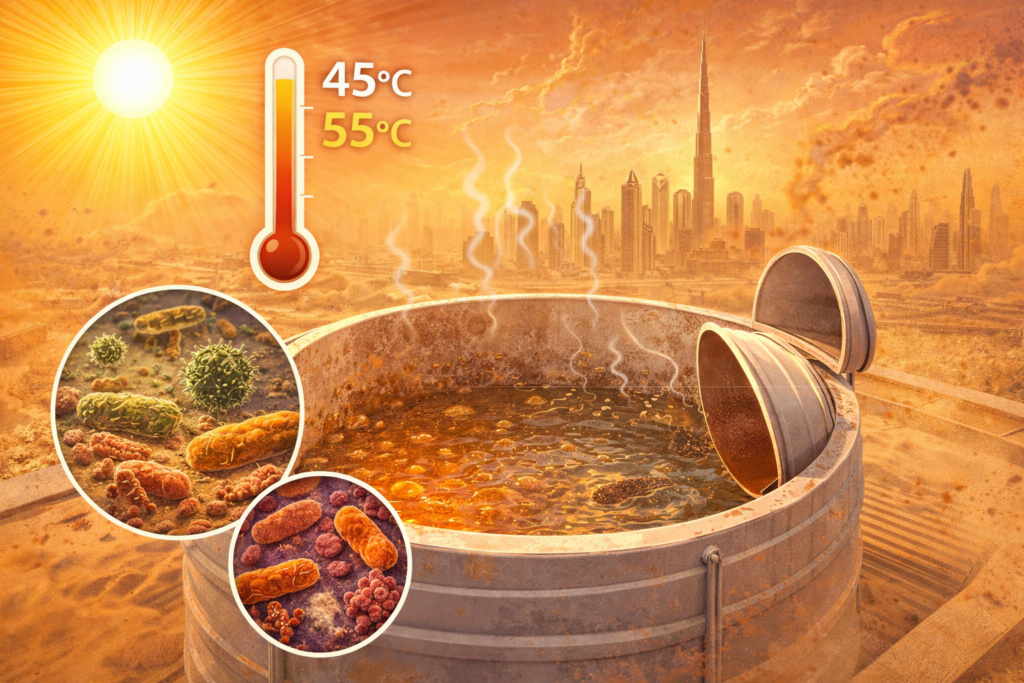
Summer temperatures regularly exceed 45°C, and rooftop tanks including the widely used GRP (Glass Reinforced Plastic) tanks and older polyethylene tanks found across older buildings can absorb significant heat from direct sunlight. Inside an uninsulated rooftop tank, water temperatures can climb to 55°C or higher during peak summer months. This is the precise temperature range in which Legionella pneumophila, the bacteria responsible for Legionnaires’ disease, thrives and multiplies at an alarming rate.
Add to this the UAE’s year-round dust and shamal winds that carry fine sand particles across the emirate, and you have a recipe for rapid contamination even in tanks that appear clean from the outside. Sand and dust carry airborne microorganisms and organic matter that enter tanks through poorly sealed lids, damaged vents, or overflow pipes.
The biology is straightforward: warm stagnant water, organic matter from sediment, and reduced chlorine residual because free chlorine breaks down faster at elevated temperatures create the perfect incubator for biofilm formation. Once a biofilm establishes itself on the internal walls of a tank, it becomes a protected colony of bacteria that standard disinfection alone cannot fully penetrate.
The Real Health RiskNeglected tanks in Dubai’s heat can harbour Legionella pneumophila (causes Legionnaires’ disease), E. coli (gastroenteritis), Salmonella, total coliforms, and Pseudomonas aeruginosa. Children under five and elderly residents are especially vulnerable. The WHO estimates that 80% of all illnesses globally are linked to unsafe water and poor water sanitation.
Cleaning Frequency by Property Type
Not all buildings are treated equally under Dubai’s water hygiene framework. The Dubai Municipality Health and Safety Department, in its Technical Guidelines for Water System Management (aligned with WHO drinking water quality guidelines), sets different requirements based on occupancy type and vulnerability of the people using the water.
| Property Type | Minimum Cleaning Frequency | Microbiological Testing |
|---|---|---|
| Residential villa | Every 6 months | Recommended |
| Apartment building / residential tower | Every 6 months | Required |
| Commercial office building | Every 6 months | Required |
| Hotel / hotel apartment | Every 3 months | Mandatory (Legionella testing) |
| Hospital / polyclinic / clinic | Every 3 months | Mandatory |
| School / nursery / university | Every 3 months | Mandatory |
| Labour accommodation / camp | Every 3–6 months | Required |
| Restaurant / food service facility | Every 3 months | Mandatory |
| Construction site water tank | Every 6 months minimum | Recommended |
| Industrial / warehouse facility | Every 6 months | Recommended |
One thing worth noting for villa owners specifically: although the six-month rule applies, rooftop tanks in detached villas face more direct sun exposure than tanks inside the core of a large building. If your villa is in areas like Arabian Ranches, The Springs, Mirdif, or Al Barsha where older or smaller GRP tanks are common cleaning every four months during summer is genuinely worth considering, even if it exceeds the mandatory minimum.
What Actually Happens Inside a Neglected Tank
Understanding the biology of a dirty water tank helps explain why the six-month rule exists and why you should never push it to eight or ten months just to save on a service call.
When water sits in a tank, mineral particles from DEWA’s desalinated supply mainly calcium carbonate, magnesium, and trace iron compounds gradually settle to the bottom and form a sediment layer. This layer is not just cosmetically unpleasant. It provides a nutrient-rich bed in which bacteria can root themselves and begin forming biofilm a slimy protective coating that bacteria secrete around themselves to resist cleaning agents and immune responses.
Simultaneously, if the tank lid is damaged, poorly fitted, or the mesh screens over vents are torn, algae spores enter from the outside environment. In a sun-exposed GRP rooftop tank, algal growth can become visible within weeks during summer. Some algae species produce toxins as metabolic byproducts a fact that makes them particularly problematic in potable water systems.
Meanwhile, as the water temperature climbs and the residual chlorine depletes, Legionella begins multiplying. It is worth knowing that Legionella is not contracted by drinking contaminated water it enters the respiratory system through inhaling fine water aerosols from showers, taps, or cooling towers. This is precisely why cooling towers and spa pools in hotels and large commercial buildings require their own separate Legionella Risk Assessment and Legionella Control Programme under Dubai Municipality’s Technical Guidelines.
Key Entity Legionella Control Under Dubai Municipality’s Technical Guidelines for Legionella Control in Water Systems (DM-HSD-GU44-LCWS2), hot water storage tanks must maintain water at a minimum of 60°C, while cold domestic water should be kept below 20°C. These temperature thresholds are the primary biological defence against Legionella growth between scheduled cleaning cycles.
What Type of Tank Do You Have and Does It Matter?
Yes, it does. The material and design of your storage tank affects how quickly contamination develops and what cleaning approach is required.
GRP (Glass Reinforced Plastic) tanks
The most common tank type in Dubai’s newer residential and commercial buildings. GRP tanks use non-porous, smooth internal surfaces with food-grade resin linings that resist bacterial attachment better than older materials. They are also UV-resistant and corrosion-proof. However, the panel joints and sealants in sectional GRP tanks can degrade over time, creating micro-gaps where biofilm establishes itself. These seams require close attention during cleaning.
Concrete tanks
Found in older buildings, particularly pre-2000 construction. Concrete is porous, which means bacteria and mineral deposits can penetrate the surface rather than just sitting on it. Concrete tanks require more aggressive scrubbing and often benefit from GRP lining or epoxy lining as a long-term hygiene upgrade. If your building has an older concrete underground tank, your cleaning provider should inspect the lining integrity during every service.
Polyethylene (plastic) tanks
Common in smaller villas and older low-rise buildings. Polyethylene tanks are lightweight and easy to install but tend to absorb heat more than GRP and are prone to algae buildup when exposed to sunlight without adequate shade or UV-resistant coating. These typically require more frequent visual inspection between professional cleans.
Stainless steel tanks
Used primarily in commercial, industrial, and food service settings. Stainless steel offers excellent hygiene properties but is susceptible to pitting corrosion from chlorine compounds if the interior surface is compromised. Any rust or scale deposits inside a steel tank should be treated as a serious contamination risk requiring immediate professional attention.
What a Proper Professional Cleaning Involves
There is a meaningful difference between a genuine professional clean and someone simply rinsing out the tank with a garden hose. A licensed tank cleaning company following Dubai Municipality standards will carry out the following process:
- Pre-inspection and risk assessment: The tank interior is visually assessed for sediment depth, biofilm presence, algal growth, rust, structural damage to linings or seams, and any dead animals or foreign matter. A responsible technician documents this before work begins.
- Full draining: All stored water is completely drained. Cleaning cannot be performed effectively with standing water present, regardless of what some budget providers claim.
- High-pressure washing and scrubbing: All internal surfaces walls, floor, ceiling, access ladders, and float valve components are scrubbed using non-metallic brushes and high-pressure jet sprays. Metal brushes should never be used as they scratch internal surfaces and create crevices where bacteria hide.
- Sludge and debris removal: All loosened sediment, sludge, and debris are vacuumed out and disposed of in compliance with Dubai Municipality environmental disposal guidelines.
- Disinfection with approved chemicals: Municipality-approved, food-grade disinfectants are applied to all internal surfaces. The most commonly used agents aresodium hypochlorite solution(chlorine-based) andchlorine dioxide, both of which are certified safe for potable water systems when applied at correct concentrations and contact times.
- Thorough rinsing and refilling: The tank is rinsed completely to remove all disinfectant residue before refilling. An initial flush through connected taps ensures the first water drawn is clean and free from chemical traces.
- Post-cleaning microbiological water testing: A water sample is taken from the tank and submitted to an accredited laboratory for testing. The report checks fortotal coliforms,E. coli,residual chlorine levels,pH,turbidity, and in high-risk facilities,Legionella. If the tank fails any parameter, it must be re-cleaned and re-tested before being returned to service.
- Compliance certificate and documentation: A Dubai Municipality-compliant Cleaning and Disinfection Certificateis issued, along with the water test results, technician details, licence numbers, and before-and-after photographs. These documents must be retained by the property owner for inspection purposes.
Warning Signs That Your Tank Needs Cleaning Right Now
If any of the following are present, do not wait for your scheduled service date. These indicate active contamination or a tank condition that poses an immediate health risk:
- Water from taps appears discoloured yellow, brown, or cloudy
- Water has an unusual odour musty, sulphurous, or chemical
- Visible rust particles or sediment at the bottom of water glasses or in filters
- Occupants reporting recurring gastrointestinal illness without another obvious cause
- More than six months since your last professional clean
- Following a period of building vacancy or low occupancy stagnant water accelerates bacterial colonisation
- After a nearby construction project, which can introduce vibration, dust, and particulate matter into water lines
- After a major Dubai sandstorm if your tank lid or vent screens are not in perfect condition
- If your tank is concrete and has not been re-lined in the past ten years
The Compliance Side: Records, Inspections, and Penalties
Beyond the health dimension, there is a very practical reason to stay on top of your cleaning schedule: Dubai Municipality inspects buildings, and they do not give advance notice.
Inspectors from the Dubai Municipality Environmental Health Section carry out routine checks on residential towers, commercial facilities, and hospitality properties. During an inspection, they may take water samples directly from the building’s supply, request your cleaning records, and verify that the company you used is on the Municipality’s approved vendors list. They also check that post-cleaning water test certificates are recent and that results are within acceptable parameters.
If your records are incomplete, your cleaning certificate is expired, or your water sample fails on-site testing, the consequences are real: fines can reach AED 50,000, repeat violations escalate to legal proceedings, and in serious cases the Municipality can order the water supply to the building to be disconnected until compliance is restored. For a commercial operation, the reputational and financial cost of that outcome far outweighs the cost of a regular cleaning service.
Compliance Checklist for Property Owners
- Book professional cleaning every six months (three months for high-risk properties)
- Only use a company with a current Dubai Municipality licence
- Request post-cleaning water test results from an ISO 17025 accredited laboratory
- Keep all cleaning certificates, test reports, and service records on file for at least two years
- Submit required reports to Dubai Municipality through the Building Permit System portal where applicable
- Ensure all tank lids, vent screens, and overflow pipes are inspected and intact after every service
IoT and Smart Monitoring: The Future of Tank Hygiene in Dubai
There is a growing trend among large facilities managers in Dubai toward installing IoT (Internet of Things) water quality sensors inside storage tanks. These devices continuously monitor parameters like temperature, turbidity, residual chlorine, and pH in real time, sending alerts to facility management systems when readings drift outside safe ranges.
While this technology does not replace the mandatory six-monthly physical clean and disinfection cycle, it provides an invaluable early warning layer particularly for large commercial tanks, hospital water systems, and hotel plumbing networks where the consequences of contamination are most severe. For smaller residential properties, the technology is becoming more affordable and is worth considering as part of a broader building maintenance programme.
A Note on DEWA’s Role and What It Does Not Cover
A common misconception among Dubai residents is that because DEWA supplies safe, treated water, the storage tank in their building is automatically safe. This misunderstands the system entirely. DEWA’s responsibility ends at the point of supply typically the building’s main inlet. Everything that happens after that, including the quality of water stored in your tank and distributed through your internal plumbing, is the property owner’s responsibility under Dubai Municipality Regulation.
DEWA-supplied water does contain residual chlorine when it enters your building, but that chlorine dissipates during storage especially in a warm, uncovered, or poorly maintained tank. By the time contaminated water reaches a tap, there may be no protective chlorine residue left at all.
This is why the cleaning requirement exists independently of DEWA’s water quality and why no level of confidence in your supply network substitutes for maintaining a clean storage tank on your own premises.
Contact Globalex Today
Call us now to book your water tank cleaning service or request a free quote.
Phone +971 55 928 6666
Email gm@globalex.ae
Address Office No 1501 Mai Tower Building Al Nahda 1 Dubai United Arab Emirates
We are available for residential, commercial, and emergency services across Dubai.
Frequently Asked Questions
How often is water tank cleaning required in Dubai by law?
Dubai Municipality mandates professional cleaning and disinfection of all potable water tanks at minimum every six months. Properties classified as high-risk including hotels, hospitals, schools, restaurants, and labour accommodations must be cleaned every three months.
What bacteria grows in water tanks in Dubai?
The most significant microbiological risks in Dubai’s warm-climate water tanks are Legionella pneumophila, E. coli, Salmonella, Pseudomonas aeruginosa, and total coliforms. Dubai’s summer temperatures above 35°C create near-ideal conditions for these bacteria to multiply rapidly in stagnant or poorly maintained tanks.
Can I clean my water tank myself in Dubai?
No. Dubai Municipality requires that water tank cleaning and disinfection be performed exclusively by a licensed, Municipality-approved company. DIY cleaning does not constitute legal compliance. Using an unlicensed contractor also does not qualify and will not protect you during a municipality inspection.
What happens if I don’t clean my water tank in Dubai?
Non-compliance penalties can reach AED 50,000. Repeat offences may result in legal proceedings, failed building inspections, and in serious cases the disconnection of your building’s water supply until full compliance is restored. Beyond legal consequences, contaminated tank water is a genuine health risk to every occupant of the building.
How long does water tank cleaning take in Dubai?
A standard residential tank clean takes between two and four hours depending on tank size and condition. Larger commercial or underground tanks may take a full working day. Post-cleaning water test results from the laboratory typically arrive within 24 to 48 hours.
What chemicals are used for water tank disinfection in Dubai?
Municipality-approved companies use food-grade disinfectants safe for potable water systems. The most common active agents are sodium hypochlorite (chlorine-based) and chlorine dioxide, both applied at concentrations and contact times that comply with Dubai Municipality and WHO guidelines. All chemical residues are fully flushed before the tank is returned to service.
Is post-cleaning water testing mandatory in Dubai?
Post-cleaning microbiological testing is mandatory for commercial properties and strongly recommended for residential buildings. Testing must be conducted by an ISO 17025-accredited laboratory. If results indicate bacterial presence above acceptable limits, the tank must be re-cleaned and re-tested before use.

